Category: Issue II

  • Sestina for the Apocalypse

    Sestina for the Apocalypse

    I heard about the apocalypse on the radio
    It was waiting on the sidewalk, driving holes in dusty concrete
    It released pastel lilies along the drying river
    I watched the wasps plummet to the ground, scattered among the flowers
    I followed the forest, listening for its devilish tune in the desert
    I sang in the dark, waiting for steady chords of rain

    They described to us the miracle of rain
    and death and deer’s head on the radio,
    buried songs of prayer in the desert
    They told us to inscribe prophecies in the concrete
    As if a god’s wish hid between groves of sweet-smelling anant1 flowers
    As if god’s gift would wash up along the river

    I used to pass by a hollow near the river
    Rainwater and mud collecting there during the rains
    The water roaring against the cove, wild as a desert flower
    I listen for its whispers on the radio;
    Like a devotee kneeling on concrete
    Like a starved yucca in the desert

    A sweltering takes among the desert

    and we can only share rice on the river
    The world crumbles around concrete
    and we tell stories of monsoon rains,
    listen to beautiful static on the radio
    what will save us: a call from the devil and grave flowers

    Nowadays we plant a trail of flowers behind us in the wind, a 10 year trek
    through the desert
    listening for oasis on the old car radio
    building our own Babylon by the river,
    humming the delicate melody of rain
    and spilling mango pulp onto scorching concrete

    They said: Tell us something concrete
    Show us how to grow flowers
    between the gaps and collect rain-
    water. We answered: the desert
    perfects death; follow the river
    listen to the radio

    Today, I saw a flower grow through concrete in the desert
    Today, I heard rain fill the hungry river
    Today, I heard the apocalypse on the radio


    Silvia is a young Queer writer living in the U.S featured in the fiction anthology, Demeter’s Garden, the Discretionary Love blog, and more. When she’s not writing, you can find her devouring fantasy books, producing music, and making zines. To find out more, you can check out her linktree here: https://linktr.ee/siivia_writes .

    1. Anant means gardenia flower in the Indian language Marathi. ↩︎
  • Appetite

    Appetite


    Armillaria moves beneath the leaf mold, sending its fungal finger-threads through earth rot-rich with lignin and decay. It is a silent network, older than the tallest tree. The veins of life. No one has mapped its reach. It takes what it’s given, making a meal of all fallen things. A wet cradle for the soft collapse of everything. At the tree line, he squats, tilts his neck to trace the arc of shelf mushrooms climbing a yew’s spine: white moon-fruit purling among the sun’s spider-lines. One breaks beneath his finger, its tissue part marrow, part sponge. Was it here you buried her? Softening enough to be digested. He listens for the carbon and nitrogen moving underground, exchanged in chemical language. Pit and pulp. Every body is a soft fruit for the soil to open. Some animal impulse in him, like a larva chewing through meat, compels him to lie belly-down and stretched out, as if to let the hyphae learn his shape. He thinks about his instruments. He thinks about all the things nature has made that man cannot immitate: lignin, chitin, keratin. He thinks about skin. A beetle clicks beneath his boot. The boundary between self and soil begins to blur. He kneels among many little moons. God is nearby, mouth open, waiting.


    Rowan Tate is a Romanian creative and curator of beauty. Her writing appears in the Stinging Fly, the Shore, Josephine Quarterly, and Meniscus Literary Journal, among others. She reads nonfiction nature books, the backs of shampoo bottles, and sometimes minds.


  • Under a Sky of Compassion

    Under a Sky of Compassion

    Under a sky of compassion
    she wandered the streets
    to erase her anger
    stumbling at every corner
    hoping that a miracle descends
    and erases her frenzy.

    There was a scent of stubbornness
    in the air that kept her trying.
    As she roamed through the darkness of the night
    where the backstreets smelled
    of forgotten love stories,
    she saw the dawn’s first ray
    pointing to her heart.

    No corner was clear of fury
    until she reached the shore
    laid on the warm sand,
    and watched the tide
    wash away all the ocean’s rage.


    Ramzi Albert Rihani is a Lebanese-American writer. He received the 2024 Polk Street Review first-place poetry award. His work has appeared in several publications in the US, Canada, UK, Ireland, Belgium, and South Africa, including ArLiJo, The Galway Review, Chronogram magazine, Fine Lines, Last Leaves Magazine, Poetry Potion, and The Silent Journey Anthology. He is a published music critic. He wrote and published a travel book, “The Other Color.” He lives in Potomac, MD.

  • My Grief Grew in Knots

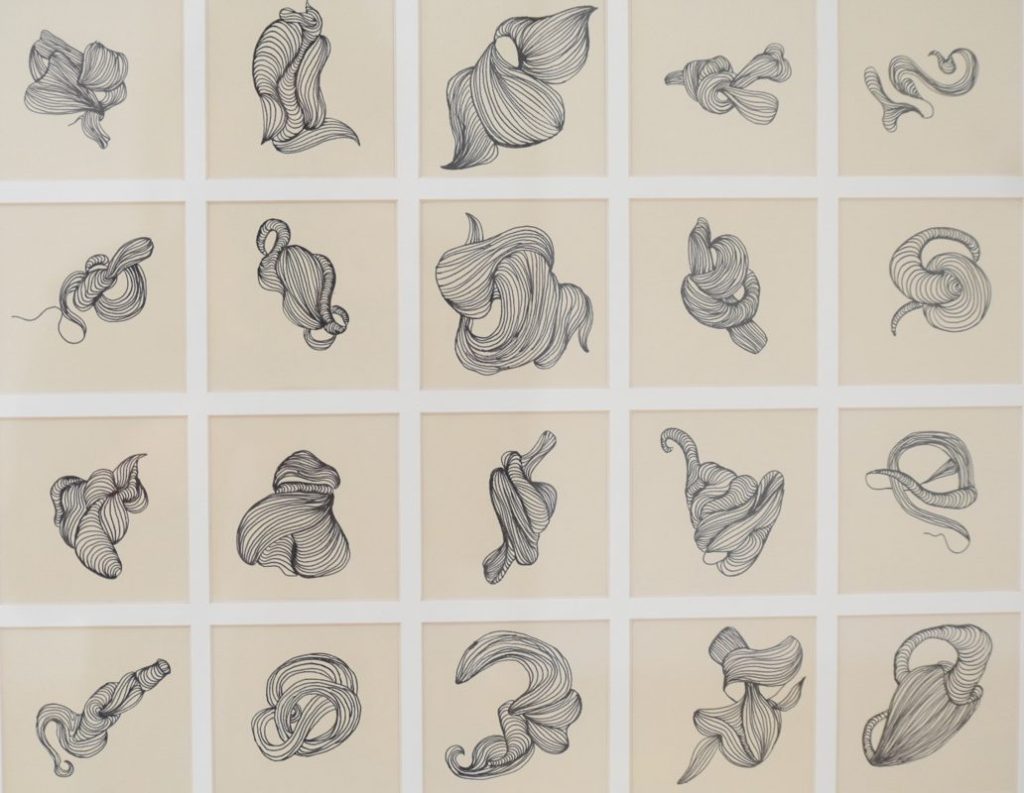
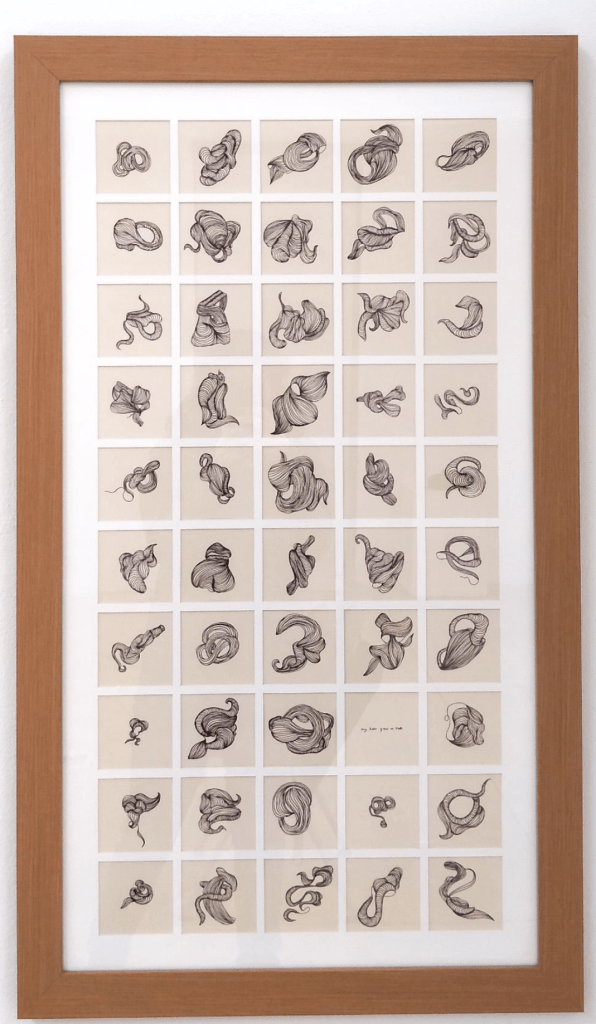
    My Grief Grew in Knots

    Tangled

    I remember
    the sound of the brush
    de-tangling my hair,
    the song you hummed,
    and how you had to stop when you laughed
    so hard
    That time
    was meaningless.

    Your fingers ran across my curls,
    helping them have the perfect shape,
    or organizing them in a braid,
    de-tangling every one of my thoughts.

    Now,
    I can’t stand the sound of the brush
    against my messy hair,
    I don’t sing any song,
    I growl
    I don’t laugh
    I get angry
    and it takes way
    too
    much
    time.

    so,
    I simply don’t touch it much,
    I don’t braid it,
    my curls haven’t been shaped in years,
    my thoughts are tangled,
    and my hair,
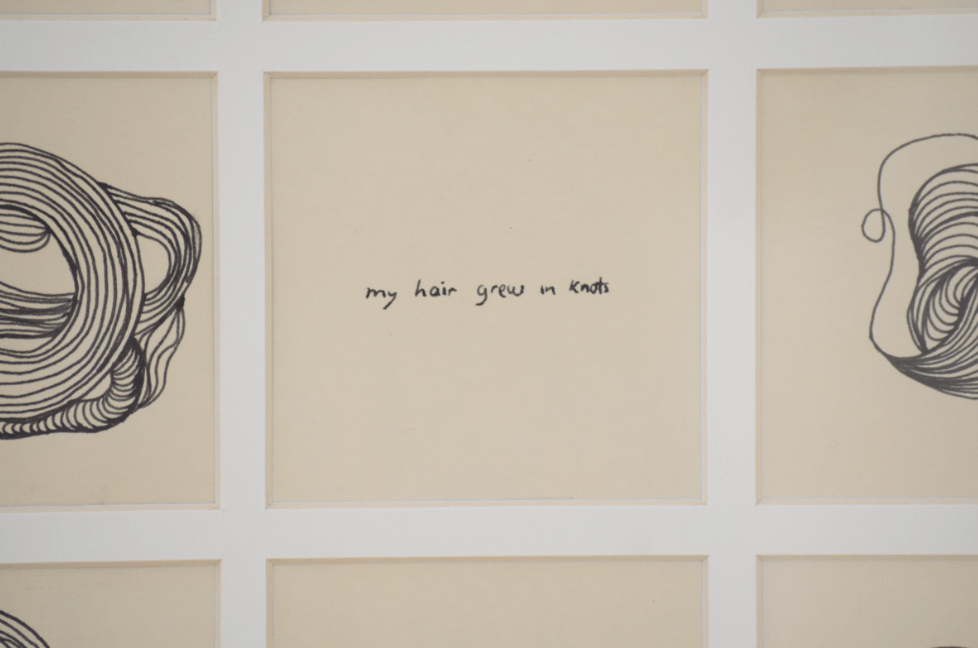
    my hair grew in knots.


    Sofía Hurtado Montes is a Colombian artist and writer with a BFA and an MFA from the Universidad de los Andes. Her work weaves together poetry and visual arts, and has been published in magazines in the UK, Canada, and the United States. Her artwork has been exhibited at the CICA Museum in South Korea, as well as in galleries in Colombia and Bulgaria. Her practice explores grief and the eternal present that accompanies it.

    You can find her on social media: instagram.com/artecedario

  • tunnelvision

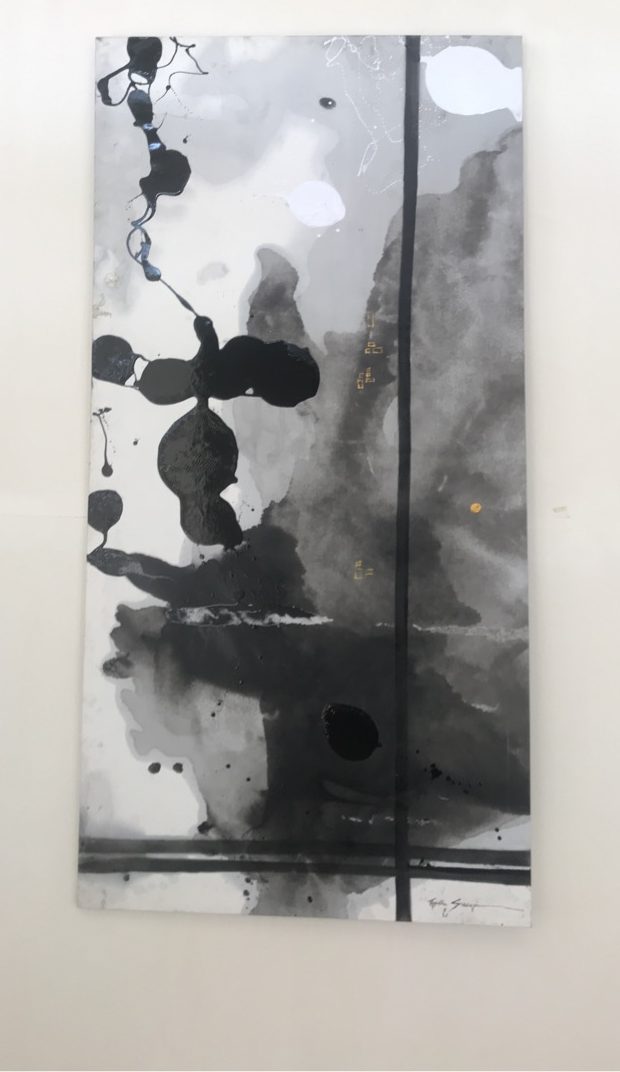
    tunnelvision


    Edward Michael Supranowicz is the grandson of Irish and Lithuanian/Russian/Ukrainian immigrants. He grew up on a small farm in Appalachia. He has a grad background in painting and printmaking. Some of his artwork has recently or will soon appear in Fish Food, Streetlight, Another Chicago Magazine, Door Is A Jar, The Phoenix, and The Harvard Advocate. Edward is also a published poet who has had over 700 poems published and been nominated for the Pushcart Prize multiple times.

  • Limpid Water of Senses & Rasile-OPPOSITE ECHOES I

    Limpid Water of Senses & Rasile-OPPOSITE ECHOES I

    Limpid Water of Senses

    Rasile-OPPOSITE ECHOES I


    Tiziana Rasile was born in Rome where she lives and works. She completed the course of study at the Academy of Fine Art. She graduated in “Museum Merchandising” and for a year she dedicated her-self to the study of the Restoration of Ancient Paintings.
    During her career she participated in numerous events and won several international awards, such as Contemporary Art Exhibition at the Complex in Quirinale; Rome, Italy, Contemporary Art Exhibition “Woman and Autumn”at Venanzo Crocetti Museum; Rome, “CONTRASTES” Exhibition – Echos’s Studio, San Paolo, Brazil and more. The work of Tiziana Rasile is present in the Private Collection of the Museum of Contemporary Art of Praia a Mare. The artist is present in the Artist’book “The Wonderful Source”- Space, Art and Nature- Library of the National Museum of Contemporary Art in Rome; Italy. She is represented by Laura.I Gallery in London

  • Anti-Scandal

    Anti-Scandal

    “Hello?”

    “Hello, is this Mrs. Winston?”

    “Dr. Winston, but yes. Who is this, and how can I help you?”

    “I’d rather remain anonymous. I can say that I work in your husband’s department. That, I can tell you.”

    “Understood. Continue, please.”

    “I’m sorry to inform you that your husband is having an affair.”

    “Interesting. Why do you think that, exactly?”

    “There’s a woman who comes into his office, between his classes. They laugh. It’s so loud. So very loud. We can hear them down the entire hall.”

    “I see. Tuesdays and Thursdays, right?”

    “Oh. Um. Yes. That’s right. That’s correct. How did you—”

    “Yeah, I’m adjunct. As such, I don’t get my own office. So it’s easier for me to just have lunch in my husband’s office, on days when I teach at the college. I’m sorry that our laughter disturbs you. I’ll try to tone it down, but I make no promises.”

    “Oh! Oh my God! I apologize!”

    “No worries at all, and have a lovely evening.”

    My grandmother’s eulogy made several references to this story, as did my grandfather’s, three years later.


    Alaina Hammond is a poet, playwright, fiction writer, and visual artist. Her poems, plays, short stories, nonfiction, paintings, drawings and photographs have been published both online and in print. Her novelette “Jillian, Formerly Known as Frog Girl” was published by Bottlecap Press. Three of her flash fiction stories (Jane Passes The Bar Exam, To Serve In Retail Hell, As Numb As I Am) have been nominated for the Pushcart Prize, all in 2025. @alainaheidelberger on Instagram.

  • Steeped In Astonishment & The Aimlessness of the Wind

    Steeped In Astonishment & The Aimlessness of the Wind

    Steeped In Astonishment

    The Aimlessness of the Wind


    Bill Wolak has just published his eighteenth book of poetry entitled All the Wind’s Unfinished Kisses with Ekstasis Editions. His collages and photographs have appeared as cover art for such magazines as Phoebe, The Passionfruit Review, Inside Voice, and Barfly Poetry Magazine.

  • Surface Tension

    Surface Tension

    Chlorine made a home inside of her. It burned her sinuses, sharp, metallic, bright. The scent of something too clean to be alive. Her throat ached, raw from the water she swallowed over what must be days now. Or had it been weeks? Time did not pass so much as circle.

    She climbed the ladder slowly, rung by rung. The muscles in her arms trembling from effort or fear. She wasn’t sure which anymore.

    Another dive. One more, and if she hits the water just right, it should work.

    She stood on the diving board, toes balancing precariously at its edge. It bowed under her, a slight sway. The water waited below. Flat and expressionless, too still to be natural.

    There were never any clues as to where the opening would appear. The surface never rippled. Never revealed any change of depth. The was no soft give at the center. It should look like a vortex, she thought.

    Or what are those things called? The underwater tornadoes that pull you down? 

    A whirlpool. 

    It should look like a whirlpool. Like a wound in the world.

    She inhaled deeply, stretching her chest until her lungs burned. She steadied herself. She had been a competitive diver once. Before this. She was judged and measured. Seen. She used to think about precision, about angles and clean entry. The geometry of perfection. 

    None of that mattered anymore. Now, there was only the descent. The surrender to gravity, the faith in falling. The hope that there was a way home. 

    She dove. 

    An assault of sensory experience that was over too quickly to register. Muscles tight, wind roaring past her ears, the world dissolving, fear. 

    The impact: cold, shocking, absolute. Water breaking, folding over her, filling her ears with the pressure of silence. Above, light fracturing into unreachable gold.

    She kicked up, breaking through the surface with a gasp. The sky above was colorless, a lid placed over the world. 

    Still here.  Always here.

    How many dives had it been? A hundred? A thousand? 

    She floated for a while, staring up, steadying her breathing, trying to feel the passage of time. She had lost hunger first, and then thirst. She couldn’t imagine wanting to drink water.

    Her skin had gone pale. White, sometimes almost translucent. 

    Another dive. One more dive, she told herself, and she’ll find it. She’ll find her way home.

    She climbed out of the pool, leaving wet foot prints on cold concrete. She thought she remembered warmth. The weight of sunlight spreading across her skin. The scent of summer rain. But even the memories seemed far away. Belonging to someone else.

    Back up the ladder. Toes curling over the edge. The pools surface glimmering faintly. Something moved below the water, slow and deliberate, like a thought forming.

    She breathed in. She let it hurt.

    She dove.


    Whitney McShan is a Texas native who lives outside of Austin with her wife and son. Her work has been featured in Hellbound Books Anthology of Horror, Instant Noodles Lit Mag, and the upcoming anthology With Teeth. She is interested in the strange, the uncanny, and the monstrous.

  • Excerpt from “Where the Truth Took me”

    Excerpt from “Where the Truth Took me”

    They had us walk into the room where Aunty lay. Her body was rigid, hands crossed, skin yellowed under the cold light. Two nights back she’d texted me that she was feeling unwell—not to worry, she insisted. Now she was arranged in an oak-brown casket. Her eyelids were half-open, as if caught in an unfinished thought.

    I pressed my palm against her chest. In an instant, the smell—the thick, chemical-sweet breath of death, sour and intimate, wormed its way up into my throat. I almost gagged. The mortuary and everything in it dissolved, peeled away. Instead, I was standing somewhere else. Not here, but back across the ocean, years ago. The smallest change in the air could still unsettle me; my chest tightened as the heat crept up through my ribcage.

    Suddenly, I was at the site of the Rana Plaza collapse in April of 2013. The worst garment factory disaster in modern history. Over a thousand dead, mostly young women, pressed together in the dirt and dust after the eight-story building gave in and folded onto itself.

    At Al Jazeera English, I’d just started. They sent me out to cover it, replacing Jay Khan—their big name reporter, blacklisted by the Bangladeshi government for criticizing the wrong people.

    Jay looked tense as he explained what I was allowed to do. “For security reasons, you’ll stay off-camera. Voice only. No public credit,” he announced, barely glancing up from his phone. “Doha approved this arrangement.” I nodded, repeating his rules in my head. Only much later did I realize how deliberate it was: he made sure there was a ceiling over me, claimed it was for my protection. But even with those limits, the Rana Plaza story changed my standing at the network.

    Jay’s driver picked me up with his producer Salim, and camera operator Shaon. The car jerked for an hour down roads that got rougher as we went. When I finally opened the door, I didn’t watch my step—I landed ankle-deep in a gutter of sticky blood. Salim reached for my arm and guided me out. We climbed a narrow staircase in the building next door, looking for a vantage point. From above, the devastation was clear. Limbs, desperate and limp, dangled from gaps in the concrete. Some bodies were broken, others still alive, their cries rising from underneath the rubble. There were no fire fighters in sight. Civilians threw ropes and reached in bare-handed, pulling survivors and the dead out from the piles. That was the only sign of hope I saw in the mess.

    But what stayed with me, past the images and the noise, was the smell. A dense, rotten-sweetness that never faded. For a month, I couldn’t get free of it. I breathed it in the air as I worked. It haunted restaurants, clung to my food and my clothes even when they tried to disguise it with cheap, rose-scented spray. The odor soaked into everything, dense and persistent. It refused to leave.

    That memory was here again, sharper than ever, overtaking the intimacy of this moment. My PTSD flaring up as I stood in front of Aunty’s casket, trying to keep myself steady. I learned once that your body remembers things your mind tries to put away. Today, that memory took over.

    I stood next to my friend as she cried for her mother. Something old and silent inside me surfaced. The smell pressed in from all sides, not just hers, but the idea of death itself. Old, honest, impossible to ignore. I thought I’d made my peace with it long ago, but it found me again—here, in Los Angeles, and in the quiet, it felt just as raw.


    Tania Rashid is a journalist and documentary filmmaker.