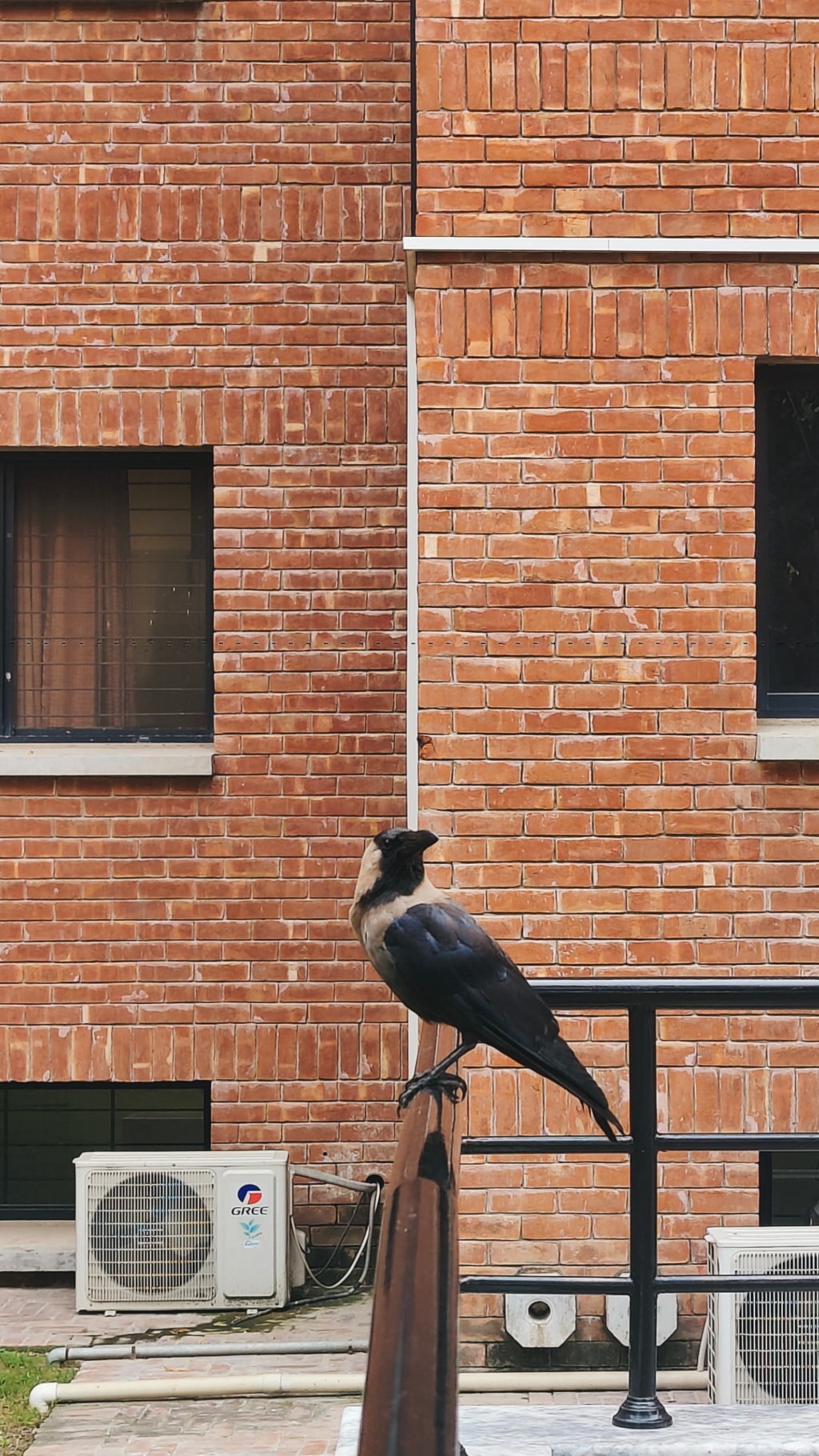
The incessant loud cawing of crows draws me out of bed at eight this cold Sunday morning. Otherwise I would not get up till ten. For the last few days some brats have been loitering about with catapults, and thinking they have shot some crow, I drag myself to the terrace. Now I don’t like crows, but the show of grief they put on by gathering together at the funeral of one of their own has always fascinated me. Their raucous calls are a reproach to all humanity, and besides they gather not only to mourn their dead, but to glean the danger in the area and to communicate it to the whole community.
The terrace looks out to the empty, abandoned site across the road where a young couple intends to build a house. Cement blocks, bricks, metal pieces, and wood splinters are strewn about the plot. For the time being the couple is living with their two-year-old girl in a room on the roof of the neighbours next door. The roof too looks out onto the plot. Beyond the lot stretch the spaces which belong to a man who has not been in town for two years, are packed with grass up to the knees, and have turned into a thick spinney. Branches matted and entwined with each other make up a thick screen and it remains gloomy.
Ten to fifteen crows are flying low, cawing loudly, returning to perch on the trees. From childhood I have been, like most of us, prejudiced against crows; the confidence of the brute majority and their uncanny wariness put me off. The way they kill fledglings and disabled and dying birds disgust me. But when I see the black cat crouching on a lower branch, peering down through the leaves, I grudgingly have to appreciate them. Count on a crow to stick to the customs of old.
This cat is the terror of the neighbourhood; squirrels, tailorbirds’ nests, moles, mice, milk and meat in our kitchens– nothing living and edible escapes its notice. It prowls day and night. However, the object of their rage is not, as I realize moments later, the black terror but a pied myna being tossed about by two young, foolish dogs. The myna seems to have been damaged irreparably. How it came to be in the clutches of these savages can’t be known.
The crows are protesting the outrage, communcating it to their feathered clan.
The dogs, though newly attained to full size, are still immature. Abandoned on the garbage heaps as puppies, they have learned mischief and audacity in place of cowering and cringing by virtue of being two in number. Not even the big dogs attack them, except for occasional bark and bite.
Perhaps they caught the myna on the garbage dump that we have accumulated in the thicket for the lack of proper arrangement. I usually see them assault all the birds playfully when they alight seeking grub on the rubbish dump. They must have dragged the myna to the plot across, clenched between their incisive, quick teeth. This is why the poor bird seems so injured, but the life in it is not exhausted. It flutters its wings wildly and tries to fly off the ground. In its clumsy attempts it rushes to the aggressors and ends up between them.
Its shrill wounded calls cause commotion among those perched on trees. There are others starlings, pied and plain, who panic at the sight of fallen one. They too are screeching. Is it a fledgling? It does look small. But one myna suddenly shoots out of the group and flies straight above the hurt bird, not daring to stay within reach of the beasts’ paws and teeth. Its efforts are passionate because it is not one of the random birds, but the mate of the attacked bird.
On the upper and lower branches of the trees other birds sit, strangely silent, except for crows who have quieted down somewhat and still circle over the site and the crying mate.
A red-whiskered bulbul clucks and flusters midway. Everyone is distracted for a moment– but the dogs. They have withdrawn to a tiny mound, and are looking curiously at the unprotected, helpless bird. I think the dogs have nipped its wings and it is unable to fly more than a few paces. It lies panting, gathering strength.
The dogs seem excited, snapping at the empty air, their muzzles quivering. They are still dazed by the act. For all their short lives they have sported with the birds, chasing them off the dumps. The birds would fly away with squeaks of annoyance. They would come back again. Maybe the myna became too comfortable with them.
I can visualise the canines chasing off the pied myna and it lingering haughtily, and then one of the dogs unexpectedly dashing and seizing it between pointed fangs, and chomping on it in a rush. Instantly the myna is cut up, disabled, and beats wings wildly. The dogs stand surprised, then charge again. The tiny, warm heart of the prey arouses their rebellious spirit. The open orange bill and the mortal panic of the bird embolden them, the scent of blood drives them crazy; still the exploit doesn’t penetrate beyond the top layers. They run each other to catch the screaming bird and, throwing it down with their mouths, fight with each other playfully. Then come back again to the bird and take it between their teeth. This way the myna gets driven to the plot and the bloodshed is witnessed by the crows, who make certain everyone around gets to hear of it.
The cat should have come to spy on who dared to make a killing, if not itself, and, seeing the mad frenzy of the dogs, have jumped up into the tree from where it stares now at the unfortunate bird greedily, tongue skimming over the mouth.
The dogs are fooling around while the myna lies neglected. Maybe it can still escape. There is suspense in the air, in all the birds assembled there. A crow zigzags over and lands on the wall. Its flapping wings fan my cheeks. It looks at me meaningfully, then moves its cunning gaze back to the killing scene. Does it want me to do something, and are they all waiting for me to do something?
Some way off, on top of the tallest eucalyptus, a kite pair has a nest in which are their two chicks and of whom they are aggressively protective. One kite still sits there looking at the scene below, indifferent and slightly contemptuous of the savage quadrupeds, regularly turning its head to survey the grounds for prey. It could swoop down and have the myna anytime. But I guess it won’t, because its chicks may not like to eat something that resembles themselves. It gives loud, squeaky whistles that are acknowledged only by crows.
The scene strikes me more as a risky game than a tragic incident. The reason is the birds’ indifference. They sit resigned to the fate of one of their own. It reassures me. I don’t think they would sit so cold and unconcerned if it were a real killing.
One of the dogs pauses and looks over at the mangled bird. It stands undecided and queer. The other dog gazes at its sibling doubtfully, pricks up its ears, gives its head a sharp turn, and advances. The myna senses the fresh onslaught and tries to hop beyond their reach. They pursue, casually, sportingly, but the myna sees the death in their eyes. The game is becoming dangerous. I should go down and intervene. Or is it too late?
The dogs intrigue me. They are still not conscious of what they are doing. But there is a wicked excitement in them which they are powerless to resist. And there is something else too that fills me with fascination, and with excitement too. The fear! The dogs look afraid. They stand back, not daring to attack, intuit that the assault can turn fatal. Yet when the myna strives to recover and flee, they can’t hold themselves in check.
It is not certain, though, whether the dogs comprehend fully what is happening. Or they do. But something of a momentum is at hand. The dogs are the most involved, and I think, most troubled too, except, of course for the myna, who is, after all facing extinction. Their fear manifests the conflict between the sudden protectiveness of the intrinsic innocence and their roused young blood. The temptation of taking a life, of being at the threshold of it, is really too much for them. They waver. I wait. We all wait.
I am rather bored with the myna. It struggles to save itself. The anger has given way to grit. Its exertions embarrass me. The dogs seem to be in the grip of something vast and beyond their grasp. They interest me and I gaze at them avidly.
For the past few days, a rufous treepie has taken to visiting the thicket, drawn unquestionably to the abundant food hibernating in the grass and on the trees. It is a member of the Corvidae. Throughout the day it clings and clambers through the branches, foraging for food. It sees the cat on the tree and lets out a great cry. The cat is annoyed and mewls.
This new bird fiercely and determinedly protests the cat’s presence. The other birds look on curiously.
I laugh at it and the crow looks at me sideways. Suddenly there is an undercurrent of reproach in the air. I stand aghast.
A woman walks out of the fog onto the road below, humming under her breath. She lives in the next lane. She halts and takes in the scene, alarmed. She shouts at the dogs to leave the myna alone. The dogs’ ferocity perplexes her and she remains uncertain. She bends down to the ground to lift a fist-sized stone which she then stands weighing up in her hand. The dogs don’t pay attention. They come on repeatedly towards the myna, maul it, and withdraw. It is almost dead. The woman seems to realize this, but has difficulty letting go. The dogs’ disregard and arrogance displease her and she swings the stone at them in annoyance.
The dogs recoil, bare their teeth menacingly, press the myna under their forepaws. They sense the woman’s hurt ego and start tearing the bird apart in mischievousness. The woman, in turn mad with fury, moves forward with stones in both her hands. They pause, uncertain; but don’t let go of the prey. I really hope she will save the myna. Even dead.
The woman swings one stone which catches the dog squarely on the hind leg. It cries, then growls pitifully. The other dog, with a sudden resolve, sinks its teeth hard into the myna (a final crunch), then runs off with it into the thicket. The woman tries to follow it, then stops, stands confused. The hurt dog whimpers and trails behind.
All at once, there is a loosening of tension in the air; a sort of relief. I want to turn and go back to sleep, when I see her. The little girl of the couple, living opposite on the roof, leans over the parapet and peers down. She may have seen everything. I flinch. The myna is gone. The other myna of the pair rests on a leafy branch, cleaning its plumage, like other birds.
There is lazy clucking among the mynas.
The child looks at me with large, curious eyes, then shifts her gaze to where the dogs have disappeared with the bird, then back at me. I am at a loss, and try to smile at her. Her big eyes bore into me and the tiny lips move to form inaudible words. I look away.
The possibility of her having perceived the killing unnerves me. I transfer my weight to alternate feet, uneasily observing the absence in the scene. I find myself unable to meet her gaze.
She holds a loaf of bread in her tiny hand from which she nibbles mechanically. The crow beside me is alert to it, I realize. I should warn her. But my tongue is stuck in my mouth. I see the crow poise to fly. The girl sees it in time and throws the loaf in terror. The loaf goes down, swirling, and the crow dives for it, but misses. The crow swerves back, nearly falling. Balancing in time, it chases down the loaf. The girl cranes her neck forward to see the loaf being nicked by another crow who has been biding its time.
On this note, I make myself scarce from the scene.
Sobia Ali is from India. Her work has been published in numerous online and print publications including The Indian Quarterly, Another Chicago Magazine, The Aleph Review, Sahitya Akademi’s Indian Literature, and The Mekong Review, among others.
ㅤ
Picture Credits: Musa Ali Chaudhry


Leave a Reply