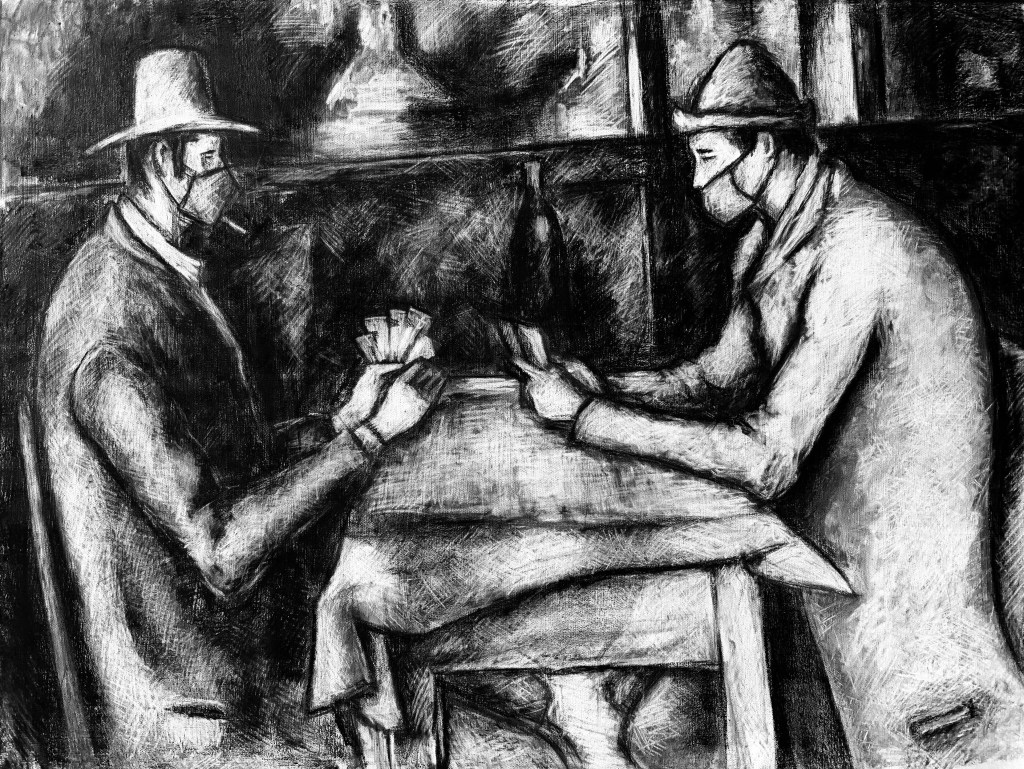
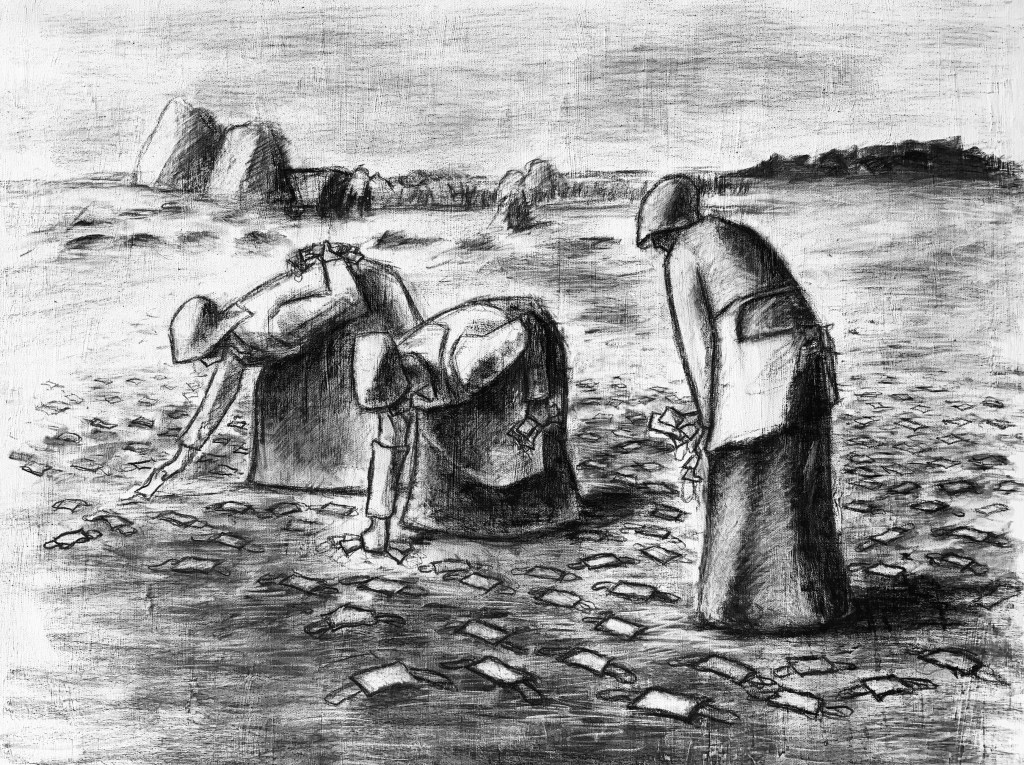
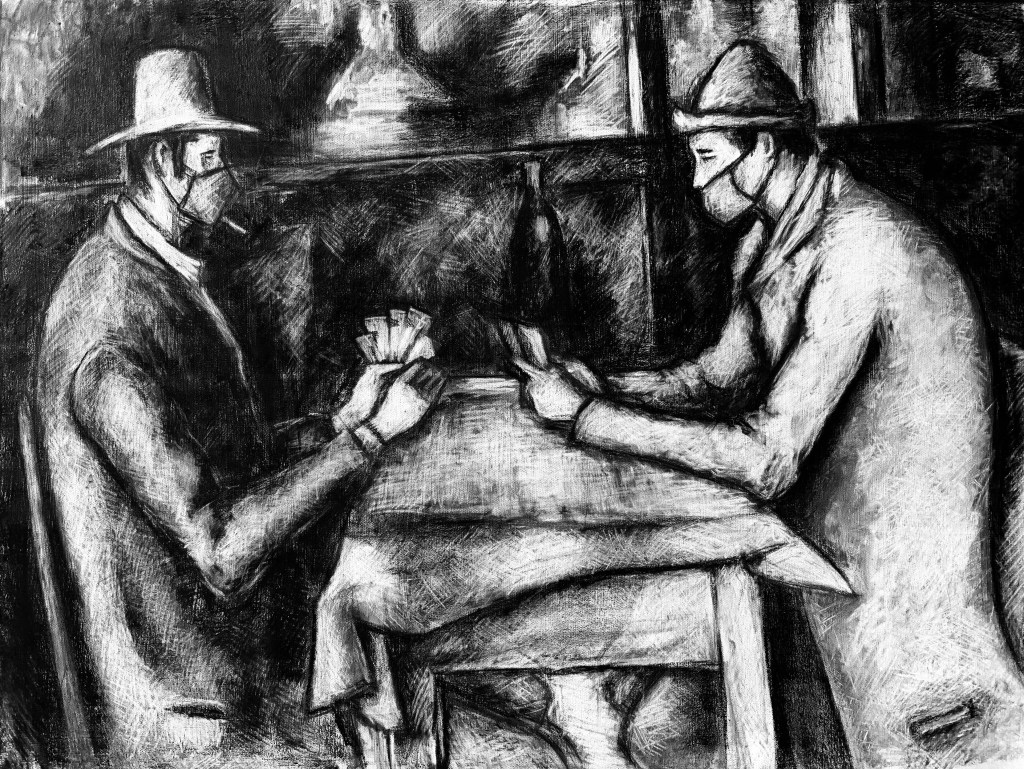
Almost overnight, COVID-19 had changed the way people interact with each other, and with our own bodies. We lived our lives in vulnerability during that historically significant time of disaster. The initial phases of the pandemic are behind us, but the virus remains and continues to be dangerous. The societal trauma this pandemic has caused will be remembered and felt by those who have lived through it for the foreseeable future.
In the past, master painters would depict historically significant disasters that happened to them as a way to cope. Artists of the 19th century depicted hardships and trauma in the wake of the Industrial Revolution which began the formation of our modern world. As an artist learning the techniques of masters, I have the opportunity to create long-lasting visual information that depicts the trauma of this pandemic.
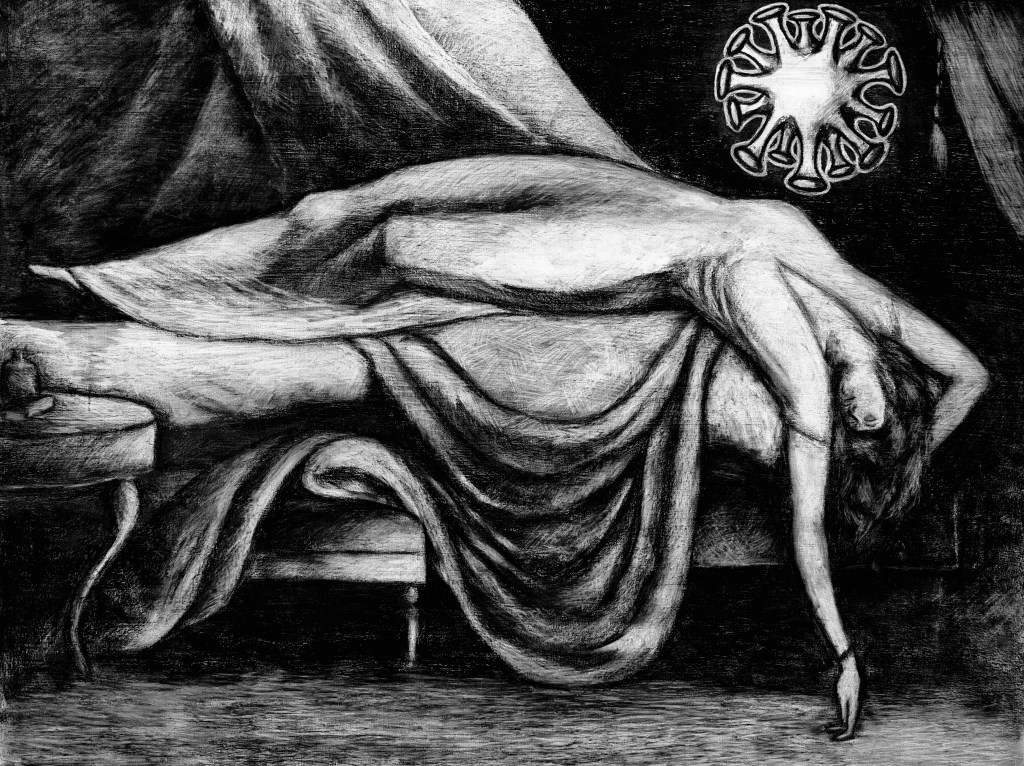
Therefore, I have created a series of drawings that represent my experiences in modern COVID life by drawing inspiration from past masterpieces that depict the embodied experience of trauma.
Mask Gleaners
The COVID Card Players
The COVID Nightmare
Donald Patten is an artist and cartoonist from Belfast, Maine. He creates oil paintings, illustrations, ceramics and graphic novels. His art has been exhibited in galleries throughout Maine. To view his online portfolio, visit @donald.patten on Instagram.
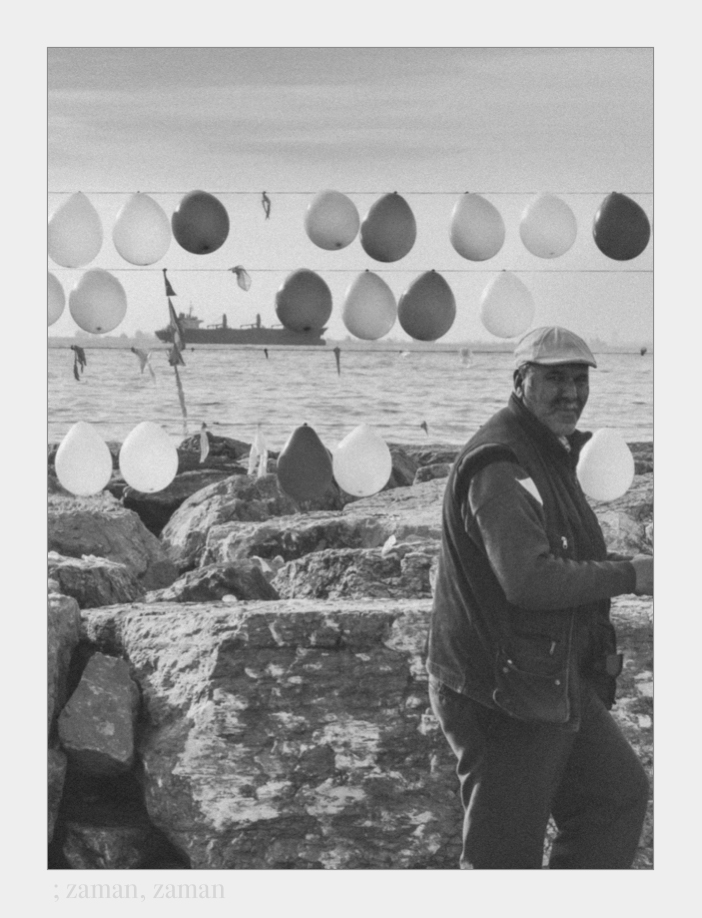
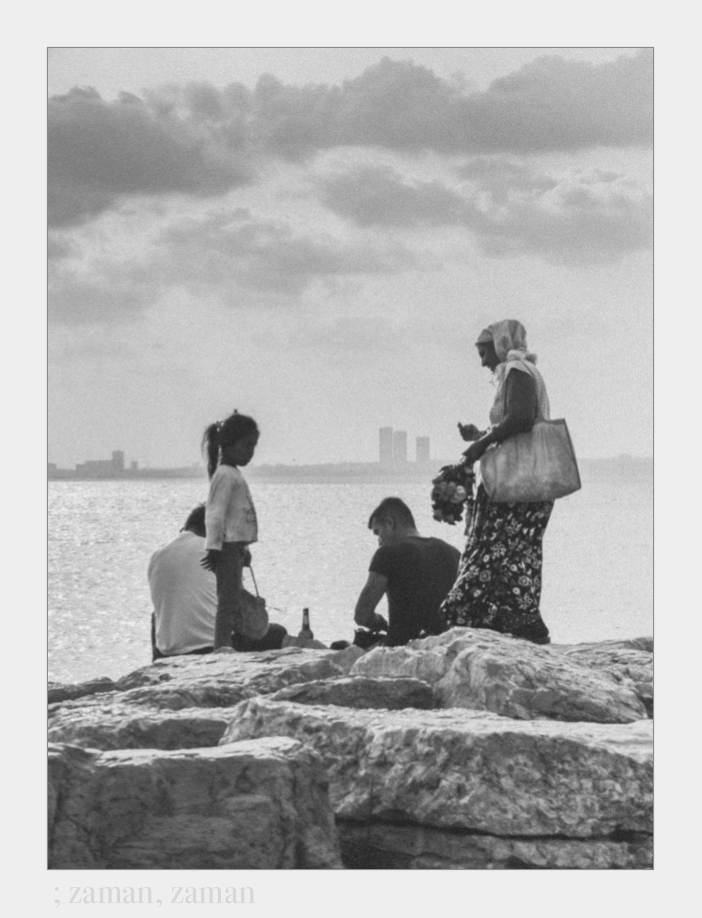
The word zaman is the Turkish word for time. When it is put together, zaman zaman, it can translate roughly to “at times” or “occasionally” or “now and again.”
G. Chagall is a writer, photographer, and educator from Kansas City. His work can be found on his Google Drive, in notebooks around his house, and online at venues such as The Flint Hills Review, Quail Bell, miniMAG, and forthcoming at The Cawnpore Magazine.
Claudia Wysocky is a Polish poet and photographer based in New York, celebrated for her evocative creations that capture life’s essence through emotional depth and rich imagery. With over five years of experience in fiction writing, her poetry has appeared in various local newspapers and literary magazines. Wysocky believes in the transformative power of art and views writing as a vital force that inspires her daily. Her works blend personal reflections with universal themes, making them relatable to a broad audience. Actively engaging with her community on social media, she fosters a shared passion for poetry and creative expression.
1.) You’ve been yucking my yum all day. What’s going on with you? -Vice President of the United State’s daughter while speaking to President of the United States love interest. (1:34)
The 2023 made for TV film Red White and Royal Blue is a movie which never saw theatres because if a fish lives above water it will surely die. When you are sitting in your bed watching it on your phone or a tasteful ipad you may think about how when fish are thrown out of water they die an embarrassing death with little to no decorum. Everyone says that the ideal death is one in their sleep, the kind where you don’t know that it’s happening. Do fish stare up at the top of the lake like it’s a ceiling and feel frightened that they will die? Do they go on new diets to prevent it from coming sooner? Is death the greatest yuck to the young man’s yum?
2.) In the reign of Queen Victoria, they were having food fights all of the time – Prince of England love interest ~ Vicky! Classic – president of the United State’s son love interest while he does the woah. (14:48)
I am almost certain that neither of the love interests in the 2023 made for TV film Red White and Royal Blue are homosexual. This is because we homosexuals are always haunted by the burning of The Library of Alexandria. You can see it in our eyes. When I watch this film I wonder if it takes place in an alternate universe where Julius Caesar minded his own business. This must be a universe where Julius Caesar never existed because that otherwise is an impossible universe. What do they call Ceaser salads in the universe of the 2023 made for TV film Red White and Royal Blue? Are there Ceaser Salads at all?
3.) In the so called cake gate controversy…you can already see the potential outlines of the president’s campaign could be about next year – Literally Racheal Maddow (19:26)
My father watches MSNBC like it might fix all the problems of the world. As if one more straight white cisgender man listens to Racheal Maddow’s voice Donald Trump might drop dead on the floor and systemic oppression might dissolve like an hourglass never to be flipped over again. I think of this when I watch the 2023 made for TV film Red White and Royal Blue, though no one wants to think of their father when they watch this movie. I think of locking everyone I know’s Dad into a room and forcing them to watch MSNBC together until they all get haircuts like Racheal Maddow and start talking like her. What did she think when she got the email to be in this movie?
4.) I’m just brushing that working class chip off your shoulder – father of president of the United State’s son love interest while him and president of the United States love interest look out at a comically bad CGI recreation of the Washington monument (20:00)
The Washington Monument is the most phallic of Washington DC’s attractions. I have not been to Washington DC, in fact I have not travelled past Utah but if I was in the nation’s capital I would make this joke. I’ve only ever dated people who wear glasses, and I am worried that people who go to small private liberal arts colleges think they know more about oppression than I ever will because I read 50 books last year and they read 70. I feel like when I talk to other middle class radicals we bump up against each other like bumper cars. I won’t believe in revolution until they learn to dance like no one’s watching.
5.) So are you still – son of the president of the United States love interest ~ Like Stonehedge – prince of England love interest ~ Your royal hardness…or Big Ben – the president of the United States’ son love interest (40:29)
At this point in the 2023 made for TV film Red White and Royal Blue I am certain I do not want God to be real. I’d hate to see such a thing cry.
6.) We’re gonna need some pizza – Uma Thermon who is president of the United States after the President of the United States love interest comes out to her. (1:08:51)
There will never be a woman president of The United States because Julius Caesar once ruled over Rome. The reason Uma Thurman with a southern accent can be president in this movie is because, as we’ve established, there was no Julius Caesar in the universe of the 2023 made for TV film Red White and Royal Blue. I fell and scraped my knee because I was so distracted thinking about this and I hated the sun a little bit more than I did before. The hardest part of being American is how often I cry over it while it throws its food like a toddler. So much of this might be solved if it had a mother.
7.) You are talking to the patron saint of gender neutral bathrooms in Austin you little shit – father of president of the United State’s son love interest (1:13:33)
My darling friend who goes to college in Ohio can’t take a dance class next term because they’ve made it law that everyone must go to the changing room of their birth gender. He has just started to grow a beard so this is a bit inconvenient. I want to live in a world with transgender infested bathrooms and changing rooms in Texas. I want to gossip at the sinks with people who aren’t afraid of the way that I walk. England has a higher body count than I ever will. What else is there to daydream about?
8.) I’m not gonna get any work done until you get these two love sick homosexuals on the phone with one another – the white house publicist? (1:36:49)
The 2023 made for TV film Red White and Royal Blue is classified as a romantic comedy, but I am growing gills and fins. God, that is all I am these days? I might be married by now if I had a better attitude, but there are some things that only ever seem to work written down and not spoken. Perhaps this is what the problem with the 2023 made for TV film Red White and Royal Blue is. Perhaps it too is a fish taken out of water dying an undignified death. I think this could be why women prefer written erotica and why yellowstone must be contained. Perhaps I will read the book and replace the dust jacket with a more sensible read like Beowulf or the poetry of Robert Frost. There will never be another discovery as great as electricity until we understand chemistry. There will never be a movie like this again until I get laid by a lesbian with a horrible taste in women…among other things.
9.) Ellen Claremort Diaz has been reelected as president – Literally not even joking Racheal Maddow after they flip Texas blue (1:49:03)
My father hasn’t been watching MSNBC lately. He realized that a man of his kind couldn’t save the world by listening to Racheal Maddow talk. I used to hear it in the background of our phone calls. I see more flags saluting Trump than Christmas lights in my hometown come December. The 2023 made for TV movie Red White and Royal Blue is science fiction because Uma Thurman is president and the Washington monument is computer generated.
Merlin June Mack (they/them) is a hemiplegic writer from Southern California. Their work explores joy, the real in the unreal and other hyper femme adjacent daydreams. Merlin has been published in magazines such as The Lavender Review, All Existing Magazine, and Twin Bird Review. Their work has also been Best of Net nominated. You can find Merlin on Instagram @merlin_june_is_a_lover or reading a book with at least one good literary motif in it. Their name is like the bird not the wizard.
Droplets punch down, diving rain becoming a mother sow’s underbelly on the scaffolding outside, new poison now, I understand and don’t want to. The storm steers me to the windows like a swimmer’s final lap, and thunder’s peroxide punch disinfects my ears with sound. I know this acid on my hand’s not safe to drink atop the heat sink. The hardware store across the street folds glass panels skyward to protect anemic palms, poison lilies, carnivores, a crowd of cramped pots watching from the floor. My Venus flytrap died last time, it was already crisp on the table when I snatched it at a discount. The shiny tag requested rainwater to live. I was almost asleep when I realized, it’s not safe. I miss its ovals of birdcage spines on the sill, waiting for flies to surprise until it stiffened, black from root to tip. I boiled water for the last times, for a spiral of coming night.
Noll Griffin (he/him) is a visual artist, writer, and musician based in Berlin, Germany. His first chapbook titled “Tourist Info” is available through Alien Buddha Press. You can find him on Tumblr/Twitter/Bluesky under @nollthere.
“You’re in big trouble now!” I shouted out the upstairs bedroom window into the inky black night. At that precise moment when I was feeling very big about it all – telling, more than warning, my oldest sister that she was in for it – the storm window inexplicably dropped with a sudden bang. The middle finger of my left hand bore the brunt of the fallen window, and the nail was shattered in two, with blood gushing from the wound.
Three of us huddled around the bedroom window that particular late evening: my sister, Jo Ann, who was two years older than me, and my sister, Laurie, who was two years older than her. It was the late winter of 1967, the year of Canada’s centenary, which was celebrated across the country. Perhaps more importantly, it was the year that my oldest sister, Cheri, had a turning point in her young life: at 14, she was discovering boys, exploring her femininity, and uncovering the more troubled side of her personality. She had gone with a group of students to Expo ’67 in Montreal earlier that year, which may or may not have been the catalyst for her rebellious and complicated nature to be exposed.
That evening our father, as usual, was working late at the gas station he owned in the town of Clinton. In addition, he also farmed; during his entire life, Dad always had two if not three jobs to provide for his large and expanding family. We lived on a farm on the first side road to the west of town. Our mother had five children by that point, between the ages of 14 (Cheri) and five (my youngest sister, Barb), with my three oldest sisters having been born within four years. This was not untypical of farm wives at that time, nor in generations earlier.
Unfortunately, due to Dad’s long hours at work, it fell on Mom’s shoulders to raise and discipline her brood. When Cheri became a young teenager and became increasingly rebellious and difficult to manage, our mother no doubt despaired. Mom had dealt with bad nerves and sporadic poor mental health for many years, the worst of which had been after my sister, Jo Ann was born, when our mother was in a deep depression for months. Since then, Mom experienced mostly good mental health, and even during difficult times, she was first and foremost an attentive, loving, and caring mother. Although we children all had moments when we tested Mom’s patience, Cheri’s teenage rebellious streak must have been a great trial to our mother.
On that eventful evening in the winter of ’67, our oldest sister had gone out with friends after school and not returned. My other sisters and I knew that Mom was both worried and upset because she suspected Cheri was in with a bad crowd. Our mother would have communicated with Dad at the gas station, but he could not leave work and, in any case, expected that Cheri would soon come home.
As the evening progressed and Cheri had still not come home, our mother became increasingly agitated. It was a school night, and Mom told us to go to bed. My three older sisters slept in the large bedroom at the top of the stairs that had two double beds in it. I had the smaller bedroom just off their room; a curtain rather than a door separated the two bedrooms. Laurie, Jo Ann, and I were in our respective beds when we heard the low rumble of a vehicle coming up the road. We jumped out of our beds and ran to the window in the girls’ bedroom that faced the gravel road in front of our house. The car’s lights were out, but from the sound, we knew the vehicle was running.
We opened the bedroom window and peered into the night, trying to see what was happening in the car. We were sure that our sister, Cheri, was in that vehicle. Finally, she emerged from the passenger’s side of the car: from the inside car light, we could see our sister in her fake fur mini jacket, tight clothing, and go-go boots. I pushed the window up higher to hear what was being said, and at that moment, I yelled out into the night to my sister. Then, unexpectedly, the window fell on my finger.
I ran downstairs and into the kitchen, and my poor mother, already obviously stressed beyond endurance, heard my tale of what had happened. She guided me to the bathroom and turned on the cold water to run over my bleeding finger with its shattered nail. The bathroom was just off the kitchen, and through the open door, my mother and I could see my sister Cheri wander into the kitchen rather provocatively and nonchalantly. Cheri wondered what had happened to me, no doubt, in an attempt to divert attention away from herself.
My mother was shaking with rage and relief, all in one commingled emotion. She had been worried sick that her daughter could have been abducted or in danger, although no doubt common sense told Mom exactly what Cheri was up to during her absence from late afternoon to late evening. My mother, who never or rarely would strike her children, said Cheri would be punished with the belt.
I was staring in amazement from the bathroom, the cold water still pouring over my numbed and near-frozen finger, as my mother chased my sister around the kitchen table. Cheri was laughing, which only incensed my mother further. As Mom went to grab Cheri, my sister’s fake fun fur jacket came off in my mother’s hands. Cheri ran out of the house and into the cold winter night on a journey that would have many repercussions for the rest of her life.
The Second Act
“Look at her…she’s not even crying!”
One of Keith’s sisters had emphatically stated these words. All eyes turned toward the front porch, where my grandmother was sitting in the same chair in which her youngest son, Keith, had always sat and watched the passing cars on the highway; because he could not go to school, it helped him pass the time by keeping track on paper the number of vehicles and other details. Keith would never sit in that chair and on that porch ever again. He had been a sickly child most of his short life until he passed away in his eleventh year.
“She’s not even crying!” my aunt repeated what she had just said to the rest of the family, gathered and grieving in the little house on the highway in the village of Brucefield that day in 1957.
My grandfather, with tears running down his face, turned to his daughters and sons who were gathered with him and said, “Your mother is crying; you just cannot see it; it is more painful to cry inside than out.”
My mother was there that day and in tears at the loss of her youngest brother, who had never gone to school because he was to some degree mentally retarded, a term that was used back then but would be considered politically incorrect now.
In 1957, Mom was only 25 years old, a young mother and farm wife who already had three daughters in the space of four years – two toddlers and a baby. When my sister, Jo Ann, was born in 1956, my mother experienced postpartum depression that deepened and lengthened for many months due to a history of bad nerves. After sessions in the hospital and specific treatments for mental illness that were considered innovative at that time, by 1957, my mother was beginning to recover. Then her youngest brother, Keith – whom everyone in the family doted on – died after a short illness, casting yet another shadow over my mother’s life.
During my childhood, my sisters and I would ask our mother about Keith, the boy whose life had been too brief. In particular, I was quite fascinated with the boy I saw in my mother’s family photo album. I was born in 1958, a year after Keith passed away, and for whatever reason, I felt a connection with him. I enjoyed hearing stories from my mother about Keith and how he loved to sit on the porch and count the cars that went by on the highway. I would wonder what it had been like for him to live a life largely at home and somewhat limited by his mental abilities. I knew he was deeply loved by all in his family: for his siblings and parents, he was their adored and special boy.
There was another story related to Keith that my siblings and I never discussed with our mother. Our cousins told us that they had heard a story about Keith and the reason for his impaired mental ability. If true, it meant that Keith had not been born mentally impaired; instead, it happened due to an accident when he was a baby. Apparently, Keith had been left in the care of two of his older sisters when Grandma was not in the house. According to the story, Keith was left alone and rolled off the sofa onto the living room floor, sustaining a lump on his head; however, at that time, it was not considered an injury with future complications. Our cousins told us that our mother had left Keith unattended momentarily. My sisters and I later speculated that if this were true, it might well account for our mother’s mental health issues that afflicted her life sporadically from her teenage years and throughout her entire life.
When I was a teenager, I began to do gardening for my maternal grandmother, whose house was just around the corner from the high school. In my final year of high school, I moved in with Grandma, whom I respected and loved as much as one would a parent. Living with my grandmother allowed me to walk to school in mere minutes and to go to my part-time job at a nearby convenience store.
During breaks in the gardening or when living with my grandmother and having time to sit and chat in the evening, I would sometimes ask her about Keith but never mentioned what I had heard as regards the possible reason for his mental impairment. However, my grandmother did tell me that although it was a significant loss when Keith died, it was also rather a relief because she had wondered what would happen to him after she and my grandfather were no longer alive. It had been one of her greatest fears, not knowing what would happen to Keith without her.
I recall a day in particular, sitting in Grandma’s attractive and neat living room when we talked about Keith. My grandmother, who raised 11 children, was always a seemingly unsentimental and practical woman and one of the wisest individuals I have ever known. When we talked about Keith that day, she peered across the room and into my eyes: Grandma told me that she had always wanted to write a story or book about her life but suspected she would never do it. My grandmother then said that she hoped one day I would write a story about her life or at least about her youngest son, Keith, to keep the memory of his short life alive. Furthermore, it should be called ‘This Old House’ because that had been Keith’s favourite song for several years before he died: he would listen to that melody and happily sing along as he sat on the front porch counting cars and watching the world go by.
The First Act
The bogeyman. The creature under the bed. The shadow that is death in disguise. The kind stranger who kills.
Childhood is a wonderful world of the imagination with extremes: at one end, the fantastical and joyful landscape of lightness and hope; at the other, a frightening and jittery underworld of darkness and fear. When I was a child, my mother told my sisters and me a story from her youth. It was when she and her siblings had experienced the mythical bogeyman who became a reality. Of course, our mother did not tell us this real-life tale to scare her children. She was at all times a fiercely protective and loving mother, despite having dealt with a lifetime of bad nerves and mental breakdowns. It seemed to me that our mother told us this story because it was still on her mind after all those years; that she could not be rid of the memory of that night decades before when the bogeyman appeared as the man in the doorway.
It was in the waning days of the late 1930s. The Great Depression was receding in the distance, but still being felt by many. In particular, there were still drifters, hobos, and men of all ages and descriptions riding the rails and wandering the roads as the 30s wound down. In the farm country of southwestern Ontario, it was common for these men to try to find temporary work from farmers. Men often stopped by a farmhouse and asked the housewife if they could speak with her husband about doing some odd jobs or being a hired hand for a time. More often than not, there was no work to be had nor even money to pay for wages, or the farmer already had a hired hand. If their husbands did not require any hired help, the housewives would usually provide any drifter with a meal or some food for the road.
At the time, parents would leave older children in charge of younger siblings when necessary. On that particular evening, my mother and her siblings were at home alone. Their parents had gone to a local function, possibly a school or township meeting. In my mother’s family, the two oldest boys would have been responsible for their four younger sisters and brother. Their ages at that time ranged from eleven to four years old. At a certain point that evening, the children went to bed upstairs at the old farmhouse in Tuckersmith Township; in each respective room, three children slept in one big bed. The three boys were in one bedroom, and the three girls were in another one nearby; both bedrooms were located near the top of the stairs. No doubt to save energy, no lights were kept burning in the house. It was in darkness. I recall my mother commenting on how dark and quiet that night had seemed. Perhaps she and her siblings felt the absence of their parents, with the knowledge they were on their own.
Creak. Creak. Creak.
The children in their respective bedrooms heard the old wooden stairs give a whispered warning that someone was at the bottom of the stairs. That someone was coming upstairs.
Groan. Groan. Groan.
The worn floorboards at the top of the stairs sounded a hushed alert that someone was now just outside the bedrooms.
“Who’s there?” called out one of the boys from his bed. No answer came back.
In the other bedroom, my mother and her sisters lay in the big bed with the blankets up to their noses, peering into the darkness. From both bedrooms, the children could just barely make out a shape in the inky darkness. An apparition. But not a ghost. A man. They could hear his breathing as he moved from one to the other of the opened doorways of the two bedrooms.
“Is that you, Harry?” one of my mother’s brothers asked the voiceless shadow in the corridor. He was no doubt hoping the figure in the doorway was their neighbour from down the road who was often at their home, and sometimes helped their father on his farm.
It must have felt to the children that the bogeyman had come to life and decided to visit their home that night. My mother and her sisters lay in their bed, hearts beating faster with rising fear. Who was the man in the doorway? Why was he not saying anything?
Then the man turned from the door of the boys’ bedroom and came back to the doorway of the bedroom where the girls were trembling under the covers.
Squeak. Squeak. Squeak.
The timeworn floorboards in the girls’ bedroom murmured their soft but urgent alarm. The dark shape stood beside the bed. The silence in the room was overwhelming.
Suddenly the bogeyman turned and started to walk back into the hallway. He paused outside the boys’ bedroom door one last time, and then began his descent down the stairs.
When the children knew the apparition, the bogeyman had left the house, they all bounded from their respective beds. All of them had been scared within an inch of their lives. They discussed who it could have been, why he had come, and why he had not spoken. When their parents returned home later, the children excitedly informed them about the nocturnal visitor. As parents, they would have wanted to allay fears, not wanting to alarm, or upset the children further.
One wonders if they were worried that something terrible could have happened to their children that night. They assumed it was a drifter or a hobo, who had entered the unlocked farmhouse, perhaps in search of food.
Who was that man?
What were his intentions?
Why did he not speak?
Were my mother and her siblings in danger?
One thing seems clear to me:
sometimes the bogeyman is real.
John RC Potter is an international educator from Canada who lives in Istanbul. He has experienced a revolution (Indonesia), air strikes (Israel), earthquakes (Turkey), boredom (UAE), and blinding snow blizzards (Canada), the last being the subject of his story, ‘Snowbound in the House of God’ (Memoirist). The author’s poems, stories, essays, articles, and reviews have been published in various magazines and journals. Selected publications: PROSE – ‘She Got What She Deserved’ (Literary Yard); ‘Destination: Cannes @ Midnight’ (The Brussels Review); POETRY – ‘Amanuensis’ (New English Review); ‘A Year in Israel, Twelve Months in Tel Aviv’ (Culterate Magazine); REVIEW – ‘Tezer Özlü’s Cold Nights of Childhood’; (New English Review); ‘Kenan Orhan’s I Am My Country And Other Stories’ (Bosphorus Review of Books). His story, ‘Ruth’s World’ was a Pushcart Prize nominee, and his poem, ‘Tomato Heart’ was nominated for the Best of the Net Award. The author’s gay-themed children’s picture book, The First Adventures of Walli and Magoo, is scheduled for publication. He enjoys duties as the editor of the online journal Masticadores Istanbul.
I am 23 years old, and getting up at 6:30 am for a car inspection where I am required to meet my father. My usually stock-white room is now colored in the pre-dawn grey. I look with passive disbelief at my cheap Target clock, remove what would be multicolored blankets in a different light, and tread to the bathroom with the slowness of an adult now often inconvenienced in the early hours by forces above themselves. My friend is on a couch somewhere in the living room, visiting from out of town.
The house, like me, is in a transition period. Before I moved in, it used to be something I particularly enjoyed (a red-brick house with different colored walls, wood and more wood, rocks in the garden and ornate chandeliers, a home fit for magical fairies or eclectic parents) and now is struggling under its new identity (black painted doors, white walls, cheap gold handles and some light fixture called ‘the Sputnik,’ a house better suited, in my opinion, for a JC Penny mannequin). While there is active construction happening in the basement, the rest of the house is suffering growing pains with the new design. The wooden floor creaks in protest as I walk to the bathroom. I shiver as I brush my teeth, moving a discarded towel over the tile with my bare feet. I would discover later that the heating has cut out, and would remain so for several days. I think about the friend from out of town that’s staying on my couch, with just the one blanket.
If being young is being fiery, being a young adult is being submissive, which is something I am learning piece by piece. I have watched my landlord (my roommate’s mother, actually) slowly turn what I would consider my dream house into my worst nightmare for the sake of “modernizing.” At first, when the mosaic tile was ripped away to make room for chalky black granite, I had to bite my tongue. When there was discussion over the stained-glass windows, I imagined chaining myself in front of them for days in protest. You just can’t mess with something like that. It’s immoral. But now, as I listen to the construction workers destroying the retro wooden walls of the basement, I think nothing. I spit out my toothpaste. I have, by 23, learned the most valuable lesson in life; that change is always going to happen, and it’s done by the hands of those with the most dough.
Maybe once, I would have been outraged by having to disrupt my schedule by my father’s ridiculous standards for car inspections (the reason it’s so early is because he “knows a guy” who’s getting me in before hours), but today I do not complain. I get dressed and walk through the dining room (thank God the table’s still wooden: the landlord’s son threatened to paint it black) and to the door. He is the one who has paid for my car, after all, and I am the subservient adult child. This might be less dramatically described as picking and choosing your battles, but to me, it feels like laying my head obediently before the axe.
In the dim light, I look with urgency to the couch in the living room. The friend, who is not really a friend but an ex I can never truly part from (you know how queer people are), is missing. Their luggage is still here, their phone…
Last night we had stayed up late talking on the couch, laughing, and musing over what our future might look like. We, because of the rule of three, are also in a transition period. In an inconsistent timeline of breakups and odd friendships, we are in a phase best described as friends who love each other but, because of “life circumstances,” cannot commit to a relationship. We show affection in passing: testing the waters more gingerly than Narcissus, a supportive word when it feels appropriate, or in the case of last night, a head on a lap, just for a second, with a sigh of relief.
I laugh to myself, looking at the couch. I realize the ex/best friend is just so curled under the blanket I couldn’t tell they were there. I shiver, putting on my coat, cursing the landlord but not the house. I send them a text from the car: “If it’s too cold, just go to my bedroom.” As I drive the twenty-five minutes to the county I grew up in, the ex/best friend leaps with astounding energy for 7am to my hardly warmer bed. We live by no label, being in this liminal space, but this feels appropriate enough an offer given the cold.
Like my bedroom, my hometown is grey, and it’s not because of the time of day or the time of year. It’s a suburban area in the county, and it is dominated by roads. It’s primary function, at least to me, is to lead you somewhere else, somewhere more interesting. My adolescence, and up until recently, my young-adulthood, can best be described as a long-term dissociation while driving over never-ending stretches of road pavement. It’s something I’m trying very hard to forget, and have tried even harder to leave.
My father, the Americanized son of Italian immigrants, has me get out of the car so he can drive it into the shop. Clearly something I’m unable to do on my own. I wait in a little room, cluttered with ads and license plates. I have a glimpse into the shop and analyze the bold, red font of the banners hanging on the walls.
My father walks in and tells me about a job opportunity he’s heard about through his work. I am shocked, but not surprised. I currently have three jobs (another learned piece: parents won’t believe you have a real job unless its one where you sit at a desk). I tell him this and he remarks he has no idea what jobs I have, and I pretend not to be hurt.
My father and I are not in a transition period; we are in the midst of an indefinite duel, in which neither of us can draw our guns. Needless to say, we suddenly have a hard time speaking to each other. I am embarrassed and confused after a long-time war with my mother (I came out last year) in which he held silence about for over a year. I had my one impulse of speaking to him about something intimate and now I don’t know how to carry myself. It’s like I betrayed my masculinity to him (I am a woman). He is hurt by my silence over the last couple months (I was dying at home, and besides, had an opposite work schedule in which we never saw each other) and my “sudden” leaving (I spoke about moving for eight months. He didn’t see why I wanted to). I expect he feels abandoned, but was never given the words to articulate that to me. Like him, I don’t know how to apologize and assure him that I love him. Stunned by our genetic stubbornness, I ask him about car maintenance to prove I’m invested in what is happening today.
He answers everything I say with a scowl. I’m about to tell him about this movie I am writing, but the mechanic comes in and I don’t finish my statement. I hug him, and he calls me to make sure I know the correct turn to make out of the parking lot.
It just starts to rain as I walk into the house. I jump into bed with Kate. I am so happy. The rain is pattering on the window, but only for that second.
Hope’s in the random. The sporadic. It comes in the night.
Sophia Indelicato is a filmmaker and writer based in Los Angeles, CA. When she isn’t making stories, she’s looking for salamanders in the woods. Her work appears in A Moment Zine.
 The Yesterday Review